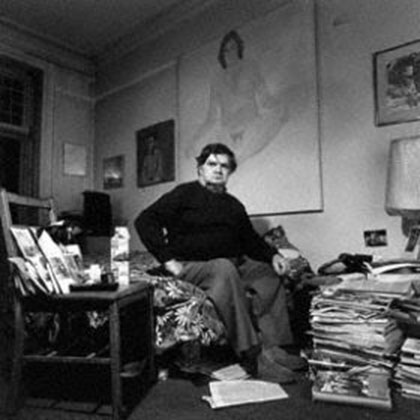
Thank you to William Johnson for contributing his insightful reading of James Schuyler’s poem ‘The Crystal Lithium’, the second in our series celebrating his centenary.
On James Schuyler’s, ‘The Crystal Lithium’
“Schuyler is simply the best we have.”
John Ashbery
I’ve always been pleased that J.D. McClatchy’s in his popular Vintage anthology chose to include all of ‘The Crystal Lithium’. In reading ‘The Crystal Lithium’ we are immediately under the spell of what this indolent poet does best, lines of supple multifaceted transcription. The definition of lithium works well for Schuyler, it is a soft, silvery, highly reactive element; that definition might describe Schuyler’s hyper reactive line as well. In a letter to Kenneth Koch, Schuyler said he took the title of the poem from a postcard: “an old timey spa, somewhere in the south Kaintuck, I think.” The notion of crystal lithium or healing crystal is that it is self-clearing, self cleansing, healthy points, generative; its optical non-linearity’s suits itself for the rich synesthesia inherent in Schuyler’s imagination.
David Schapiro states Schuyler has a “meticulous Williams like devotion to the physical world.” He often seems like he looks out a window and transcribes or more carefully according to Joseph Comte, reveals “being and cognition as a continuum rather than as a dichotomy.” “The Crystal Lithium,” exfoliates in long Whitmanic lines, the ordinary, the daily and in this poem more specifically the weather: snow. Schuyler lived with the painter Fairfield Porter’s family in Maine and this poem seems very much like Maine. It tracks snow on a beach but through its associations the poem also becomes very domestic, covering carpentry work, taking out the garbage, images of summer lawns, Christmas trees, a monthly almanac, and trips to the supermarket, the gas station all with a small town feel. Barbara Guest felt Schuyler was an “Intimist” very much like Edouard Vuilliard, that wonderful painter of fabrics who captured so well the texture of French interior life.
To understand the idiosyncratic intelligence of this poem, one must follow the long sentences whose meanings seems to spiral and through different sensory associations reconstitute themselves. It has something of that same acrobatic motion of children playing the string game, Cat’s Cradle, where participants continue to magically change the form of one solitary element or string. Schuyler begins “The smell of snow, stinging in the nostrils”. This immediate sensorium establishes that we need be facile with the interplay of the five senses if we are to process the logic of movement inherent in the poem. The poem gets its momentum through a series of brilliant adhesions. Under street lamps “the air is emptied to an uplifting gasiness/That turns lungs to winter waterwings, buoying…”. Thus the vapor beneath the streetlight is deftly pulled through the body and becomes a wintery exhalation. Schuyler continues on and frozen aspects of the waves become salt which he associates with the taste of biting a hangnail and no doubt tasting the body’s salt. Then he associates nail with its homonym nail. He comments on what to a carpenter is its metal flavor and its coldness when pounded in place has a marble like coolness. What keeps us reading this poem is a fascination with Schuyler’s hyper-realism and his facile associations. His is the same delight one might feel if he were suddenly at a 1930’s Virginia barbershop and heard a group of men jawing or doing the dozens –verbal play at the foundation of Rap. The subject shifts feel akin to riffs in jazz. From the Poetry Foundation archive this comment by Guy Davenport in the New York Times Book Review, “Schuyler’s poetry channels the world through a single sensibility” and makes it part of “a new romanticism…and a new subjectivity.”
At heart Schuler is a constructivist. He wins meaning by constantly reformulating and rebuilding sensory perceptions. He most resembles the painter Kurt Switters. Schuyler’s tone is conversational and accepting, tolerating anything that wants to be transfigured into verse. A
Christmas tree grinds to shore and its tinsel evolves into damp electricity. He mentions chapped lips and then begins a series of images or adhesions that includes, sheep wool fat, greasy sense-eclipsing fog, steamed glasses, shimmering blacktop, then heads into summer until coming back with images, graying up for more snow and dusty kitty colored birds. “Graying up” may be the common association that holds that improvisational catalogue together. When he makes a declarative statement it can seem to be more resonate with meaning. Some include “The sea is salt/ And so am I” and later ““Now you see it, now you don’t” the waves growl as they grind”…so Schuyler gives a time and its desultory effect. He states ““A place for everything and everything its place” how wasteful, how/wrong”. And at the end of the poem reaffirms his belief in change “Happiness or love mixed with them or more that they or less, unchanging change”.
The territory this poem covers is weather so much so it begins to record an almanac: “January, laid out on a bed of ice, disgorging/February, shaped like a flounder, and March with her steel bead/pocketbook,/And April, goofy and underdressed….”. It eventually mentions short days and goes into the description of a small harbor in February. When “The ice boats furl their sails and all pile into cars and go off to the super/market” the poem returns to summer. Throughout the poem there are fleeting addresses to “you” but none really take hold in narrative form. Early in the poem one may be hammering in some nails then later taking garbage out into the snow. Late in the poem a summer scene one is seen hugging a car. There’s the whimsically inventive line “–What a paint job, smooth as an egg plant: what a meaty chest, smooth/as an egg plant.” Like particles reconstituting themselves summer into winter there’s a …”cheap dump/Where the ceiling light burns night and day and we stare at or in other eyes in hope the other reads there what he reads: snow, wind…”. Like the ecstatic nature of Whitman, Schuyler ends the poem, “look in my eyes.” David Lehman called Schuyler “Quietly Whitmanic, a planetary celebrator.”
As readers know, Schuyler eventually spent some time in mental hospitals. In explaining the title of this poem to Kenneth Koch, he stated crystal reminded him of snow. Schuyler goes on to say “I thought everybody knew what Lithia water was, or is. At my house they use to guzzle it like Perrier water. Or club soda.” Despite some misreading of the title we can apply Corbett’s favorite Tolstoy quote once again: “The aim of the artist is not to solve a problem irrefutably, but to make people love life in all its countless, inexhaustible manifestations”. Schuyler was only fleetingly a confessional poet. He was a master of the physicality of the line. His work is supple. It is similar to what Edwin Denby said about dance that in its essence it is risk and the recovery of balance. Through Schuyler’s supple associative clusters and felt physicality ‘The Crystal Lithium’ deserves to be one of our more enduring poems.
William Johnson tends his garden and paddles on the Cuyahoga River. He’s been published in the Denver Quarterly and the much missed Antioch Review.
You can also find a brilliant and insightful conversation about James Schuyler, and which mentions this poem, between Charles North and Martin Stannard here.
Photo credit: Mark Woods

 Lifesaving Poems